Please click here for our Eventbrite page where you can find all out upcoming events.
We have been reflecting on what Scotland’s Public Service Leaders need and are asking for in the context of Public Service Reform, the SLF Co-Chairs with support from the Strategic Steering Group, agreed to develop a programme of more regular, half-day, in-person events and engagement opportunities, supplemented by a suite of affiliate SLFx on-line sessions. This ‘drumbeat of SLF events’ is offered instead of the annual SLF Conference.
Interested in running an event for SLF members?
SLFx are affiliate events organised for SLF members by other members and affiliated organisations. The SLFx events supplement the core in-person programme run by the SLF team. If you are interested in organising an SLFx event, please get in touch via scottishleadersforum@gov.scot.
Past events
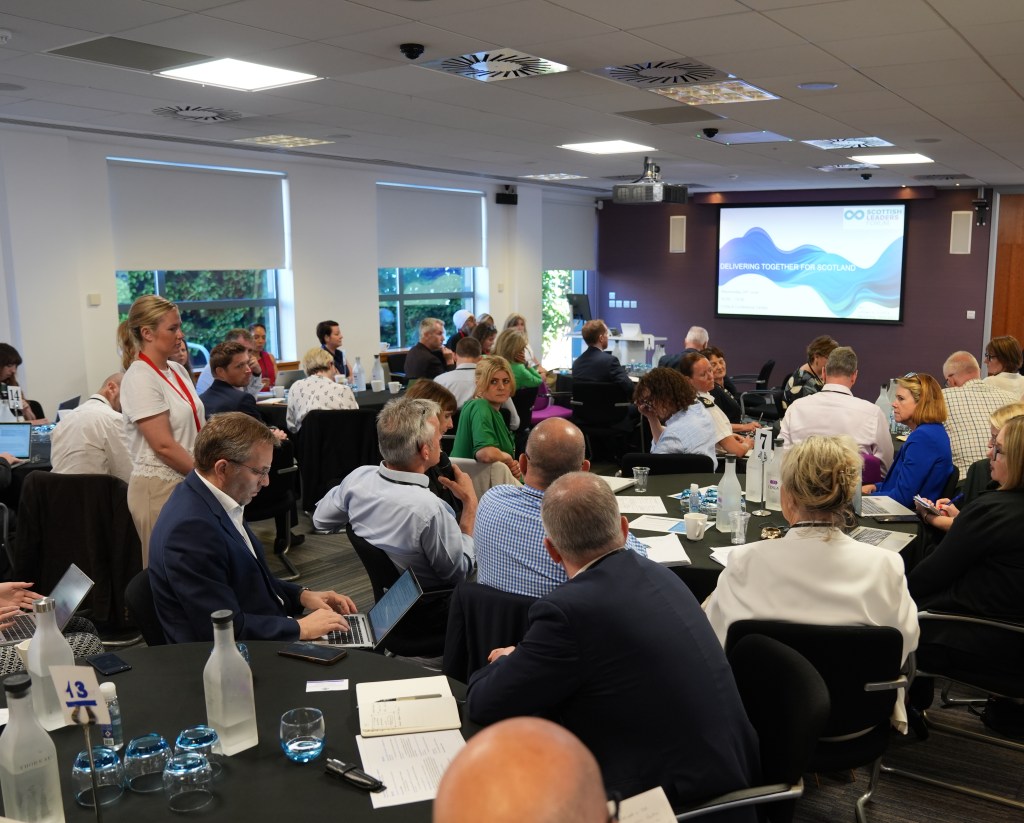
Delivering together for Scotland – 24th June 2026
Over 100 of Scotland’s most senior public service leaders were invited to join the “Delivering together for Scotland” event at COSLA Conference Centre in Edinburgh on 24th June 2026.
Expertly hosted by Nicola McEwan, Professor of Public Policy and Governance from the University of Glasgow, we were fortunate to hear from some great speakers, including – the Cabinet Secretary for Public Service Reform – Ivan McKee, Rami Okasha, Chief Executive, Children’s Hospices Across Scotland (CHAS), Jane O’Donnell, Chief Executive, COSLA and our guest panellists – Nicole Paterson (Scottish Environment Protection Agency), Karen Reid (Public Services Delivery Scotland), Des Murray (North Lanarkshire Council) and Joe Griffin (Scottish Government).
The event brought together leaders from across Scotland’s public, local government and not-for-profit sectors to explore how Scotland can drive public service reform through stronger collaboration, excellent systems leadership and shared accountability. It was designed to align effort behind the First Minister’s vision for public service reform, strengthen a “Team Scotland” approach and re-energise senior leaders by creating a space for shared leadership and problem solving. Leaders were invited to share their thoughts on system readiness for change and transformation and to offer reflections on the draft Leadership Statement which is being developed to support the leadership and cultural change work in the PSR Strategy.
During his address, the Cabinet Secretary for Public Service Reform announced a new Prevention Unit to promote prevention and early intervention across public services. The unit is part of a suite of actions for the Public Service Reform Strategy and aims to help public sector organisations focus on preventing problems early to improve outcomes and make better use of resources.
Themes from table discussions:
The need for a clearer shared vision – delegates welcomed the ambition but called for a clearer long-term vision to align efforts around shared outcomes and support decision-making.
Moving from ambition to action – delegates stressed the need to move from strategy to implementation, with clear accountability, practical approaches and a strong focus on outcomes.
Collaboration, trust and relationships are critical – delegates emphasised that successful reform depends on strong relationships, trust and shared leadership across organisational boundaries, with collective ownership of outcomes.
Leadership must be demonstrated through action – delegates stressed that the behaviours and principles set out in any leadership statement must be embedded through recruitment, development, performance management and accountability processes.
System Barriers – delegates identified governance complexity, siloed working, risk aversion, and existing funding and accountability arrangements as barriers to reform. They noted that changes to system and incentives will be required to enable better collaboration.
Overall, leaders demonstrated a strong commitment to reform and a shared determination to work differently in order to improve outcomes. Delegates agreed that future success will depend on creating the conditions for change: a clear shared purpose, stronger collaboration, effective leadership and systems that enable, rather than constrain, innovation and delivery.
The central message was clear; we know that needs to change: the challenge is turning that shared understanding into sustained action.


SLFx Online session “Deloitte’s Center for Government Insights”, 6th October 2025.
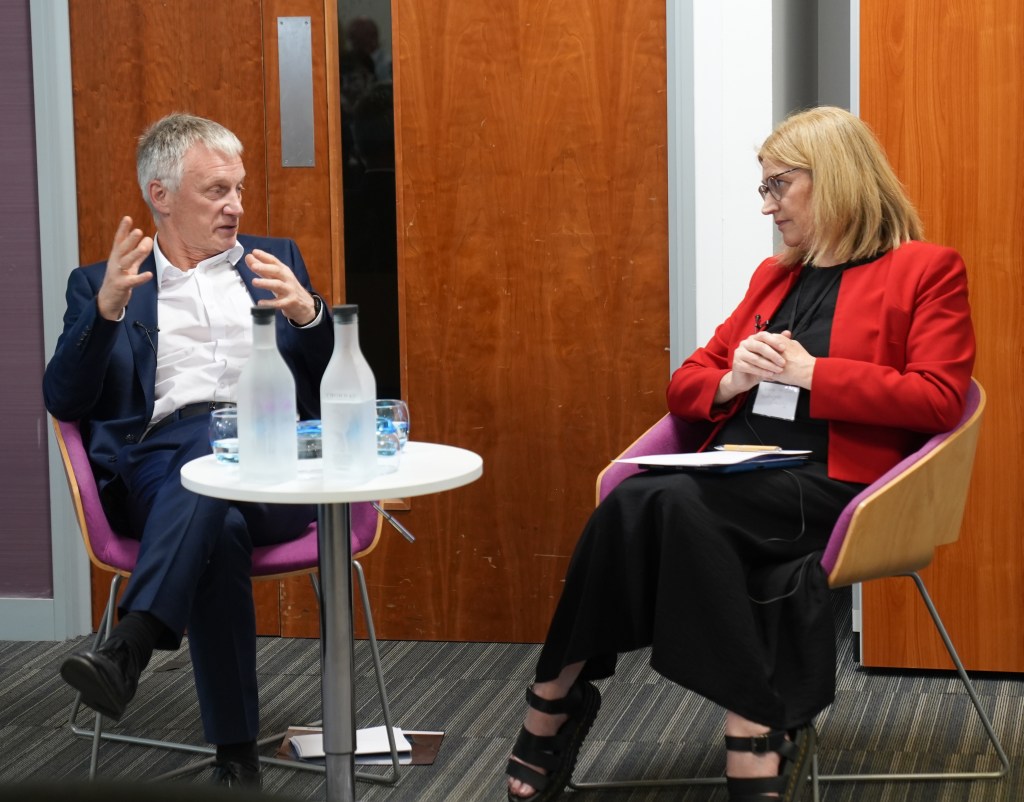
Thank-you to all the delegates who joined us on 6th October for the Deloitte’s Center for Government Insights online session, hosted by Catherine Topley, Chief Executive Officer, Student Awards Agency for Scotland on behalf of the Scottish Leaders Forum.
The SLF welcomed William D. Eggers, Executive Director at Deloitte’s Centre for Government Insights to discuss international examples of government reform, digital transformation and how public-private partnerships can deliver public value.
The session focused on learning from international examples of government reform and there was space for reflections and questions around how these international insights may help address some of the key challenges that people are facing as we work to deliver public service reform in Scotland. Delegates also had the opportunity to ask William questions about some of the wider challenges and reflect on the implications for their own work.
Please see below a link to the video of the presentation and the slides:
Whole Family Support – Getting it right through collaborative leadership – 25th June 2025
Over 160 Public Service Leaders came together on 25 June for the First Minister’s Leadership Event on Whole Family Support focused on how to ensure that every family gets the support they need, when and where they need it.
The event was expertly chaired by Professor John H. McKendrick and facilitated by Professor Carol Tannahill OBE, Joseph Rowntree Foundation, with insightful presentations from a range of panellists, and lively contributions from the delegates.
In the morning, we heard from Prof Donna Hall, CBE and colleagues from South Ayrshire Council: Kevin Anderson and Martin Calder with their case for Radical Place Leadership. Martin’s powerful poem “Too many Professionals” deserves a special mention (see below).
Following that, delegates enjoyed a fantastic session with members of the Scottish Prevention Hub, Co-Director Clair Thomson and Assistant Chief Constable Catriona Paton, joined on stage by Leah Black, Co-head of Regenerative Futures Fund, Paul Lawrence Chief Executive at The City of Edinburgh Council, Alison Gordon Chief Social Work Officer at the North Lanarkshire Council, and Ross McGuffie, Chief Executive at the NHS Forth Valley. As a result of their collaboration, the “10 Enables of Systemic Collaboration for Whole Family Support” became a focal point and a useful framework for discussions about the art of collaborative leadership.
The final plenary session was a lively panel discussion with Judith Turbyne, CEO of Children in Scotland, Councillor Maureen Chalmers, Paul Johnston, CEO of Public Health Scotland, Julie Humphreys OBE, Director for Tackling Child Poverty and Social Justice, and Cabinet Secretary for Social Justice Shirley-Anne Somerville.
Louise Macdonald OBE FRSE, Director General Communities, delivered closing remarks reflecting on the proceedings of the day.
We would like to sincerely thank all of our speakers and panellists and to all of you who attended the event – thank you for your time and contributions.
We kindly ask you to encourage your colleagues to attend the follow up event in September.
We would also be very grateful for any feedback that you may have on the event. Please complete this short feedback form https://lnkd.in/g3jZz9Ck or alternatively feel free to email us on ScottishLeadersForum@gov.scot
Listed below is a poem recited by Martin Calder during the event, and the delegate pack.
SLF online: Cultures and Leadership for Integration (CLI) in Health & Social Care, 27th May 2025. Readout
Thanks to all the delegates who joined us on 27th May for the NCS “Cultures and Leadership for Integration in Health & Social Care” online session, hosted by Ian Turner, Deputy Director for Adult Social Care Workforce and Fair Work, Scottish Government on behalf of the Scottish Leaders Forum and Future Workforce – Culture and Leadership Team.
The SLF welcomed Professor Stephen Gibb, University of West of Scotland, and Dr Anne Hendry of the International Foundation for Integrated Care, who shared the work they have been doing in partnership with the Scottish Government, including a research and practice convention on Culture, Leadership and Integration. The literature review and convention report provide further detail.
The session focused on the key insights and recommendations emerging from the work so far and how we can use these findings in the work we do. Delegates also had the opportunity to ask Stephen/Anne questions about some of the wider challenges to implementation and reflect on the implications for their own work.
Next steps:
- UWS will now begin to actively socialise and disseminate the reports and recommendations and evaluate their application in practice.
- UWS are in the process of creating a CPD module which aims to enhance leadership skills, foster cultural awareness, and support integration across the health and care sectors. This is likely to be available by September 2025. Subsidised places on the course will be available. If you or colleagues would be interested in taking one of these, please contact Professor Gibb at Stephen.Gibb@uws.ac.uk to express your interest.
- Scottish Government are also considering the best way to follow up from the convention, and how the findings fit in with wider programmes of reform including the newly launched NCS Advisory Board, GIRFE and SLIF.
Through research and shared best practices, we can ensure that our health and social care system truly enables integrated, compassionate care and support.
Please see below a link to the video which shows the presentations.
21st Century Public Servant Event, 5th March 2025, Readout
With thanks to all delegates who joined us last week on 5th March for the 21st Century Public Servant online session hosted by Pippa Milne, CEO of Argyll & Bute Council, on behalf of the Scottish Leaders Forum. The event was hosted with Scottish Government’s Policy Profession and Research Profession in collaboration with Professor Catherine Needham of Birmingham University and provided an opportunity to learn more about what it takes to be an effective and impactful 21st Century Public Servant.
We had a deep drive into the 21st Century Public Servant project and discussed how its findings can improve our leadership at a pivotal moment for public service reform. Delegates also had the opportunity to ask Catherine questions about how the 21st century leadership ideas might work within their organisations and for senior leaders across Scotland’s public services. Smaller in-depth discussions took place where delegates were then able to reflect on what they had heard during the presentation.
Please see below a link to the video which shows the presentation and discussions in the first part of the session.
We can’t be protective of territory to the detriment of outcomes. We must work together for the common good – that needs to be front and centre.
Themes from the session included what it means to be authentic, the importance of relationships, investing in learning and development, organisational culture and the emphasis, of course, on the skills/mindset needed to operate in complexity.
Authenticity. One of the key elements of good leadership that comes up regularly is the importance of good relationships and a reflection on what it means to be authentic in a leadership role. For Catherine, being authentic means being able to say, ‘I’m on the journey with you, I’m here to learn’ and being able to recognise our limits, acknowledging what we don’t know. It’s about having the skills to bring people along with you when you know you’re not the strongest on what’s required.
Safety. Being in the spotlight can be hard. Safety enables people feel to innovate and experiment in environments where incivility and trolling is rife and geo-political pressures impact locally as well as nationally. The inbox, social media, can be overwhelmingly negative, it’s important to connect with people in person to take the temperature in real life to bring better context and objectivity. The work we do and the world we live in is complex and it’s really difficult to convey in a social media post. This is particularly important when trust in public institutions is the lowest it’s ever been. It’s so important for public servants to invest in reestablishing trust.
Learning and Development. Investing time in learning, in relationships and building skills, is even more critical when we’re working in crisis. However, skills require the right kinds of organisational culture / environment to be practised and strengthened. Too many people find themselves taking what they have learned back into risk averse and toxic workplaces. We need as much emphasis on the ‘why’ of collaboration and relational, as well as the ‘how’. We also reflected on how leaders are developed and supported, particularly those people who don’t think they are capable but who are – confidence over competence remains a risk.
There was a real emphasis on building collaboration skills and collaborative mindsets, being mindful of system/output pressures which inhibit that practice.
The session included an exchange on optimal ‘models of leadership’. We hear a lot about particular ‘models’ / approaches, and we’re also starting to hear increasing scepticism about needing to settle on one or more models and an emphasis instead on drawing a range of skills, behaviours and insights, to address challenges. However, an emphasis on leading across and within complex systems is fundamental and recognising where that is working well would be helpful, however, we have a long way to go in terms of describing where long-term, strategic and sharing generously is a real experience outwith particular organisations or sectors.
New Public Management approaches were identified by a number of attendees as a major blocker. This isn’t to undermine the need for good public administration, but top-down approaches and gaming KPIs hold us back from doing the right thing well rather than the wrong things efficiently. Command and control, centralisation – people are constrained by the system / structures.
SLF online: Leading Together, Public Service Reform, In Conversation with Mr McKee and Cllr Heddle
Monday 18th November 2024, Online Event
Thank you to everyone who attended the above event online to hear from Mr McKee and Cllr Heddle about what’s important to them, what it means to lead collaboratively and the critical role that excellent public service leadership plays in driving public service reform.
A readout/summary from the event is provided below;
Collaborative Place Leadership & Public Service Reform
Tuesday 24th September 2024, Online Event
Thank you to everyone who attended the above event online to learn more explore innovations in place leadership and collaborative working within the wider context of public service reform.
A readout/summary from the event is provided below;
Collaborative Leadership Across Systems
Monday 24th June 2024, 13:00 – 16:30, Grassmarket Community Project
Thank you to everyone who attended the above event in-person to learn more about work of ‘reform clusters’ that a range of Scotland’s Public Bodies and Local Government leaders from culture/historic environment, net zero/environment, and digital, have been driving as part of the programme of public service reform.
A readout/summary from the event is provided below;
—————————————————————————————————
SLFX COVID Seminar – Tuesday 28th May, 12:00 – 13:30, Online
SLF COVID Lunchtime Webinar – What next? How learning from COVID-19 can support Scottish Leaders to create a better future.
Tuesday 28th May 2024, 12:00 – 13:30, Online
Thank you to everyone who attended the above event with Professor Linda Bauld, Chief Social Policy Adviser at The Scottish Government, for this ‘SLFx’ lunchtime webinar on Tuesday 28 May at 12:00-13:30 (online) organised in collaboration with the Improvement Service & Corra Foundation.
In November 2023, the Covid-19 Learning and Evaluation Oversight Group published a report: ‘Learning to inform Scotland’s recovery from COVID-19’. This report synthesised evidence from evaluations of Covid-19 interventions and a series of workshops with senior leaders from across Scotland.
This lunchtime webinar was ran by the authors of this report, in collaboration with the Corra Foundation and the Improvement Service, to highlight and operationalise the key findings around themes such as trust, collaboration and partnership working, risk and accountability and equality and inclusion.
Attendees heard about the following:
- Key learning on how the pandemic led to lasting change in the Corra Foundation and the Improvement Service.
- How they have been working with partners to successfully make and retain changes in their organisations around these themes and some of the challenges involved in embedding this learning.
Please see a link to the slides from this event below;
Launch of the National Covid Recovery Strategy
On 5 October 2021, John Swinney, Deputy First Minister and Cabinet Secretary for COVID Recovery, and Cllr Alison Evison, COSLA President, shared their ambitions for Scotland’s public services in the context of the national COVID Recovery Strategy. This online event offered Forum members an opportunity to ask questions, share reflections, and explore the key role of leadership in implementing the strategy. A short thematic summary of the event is available to read here: